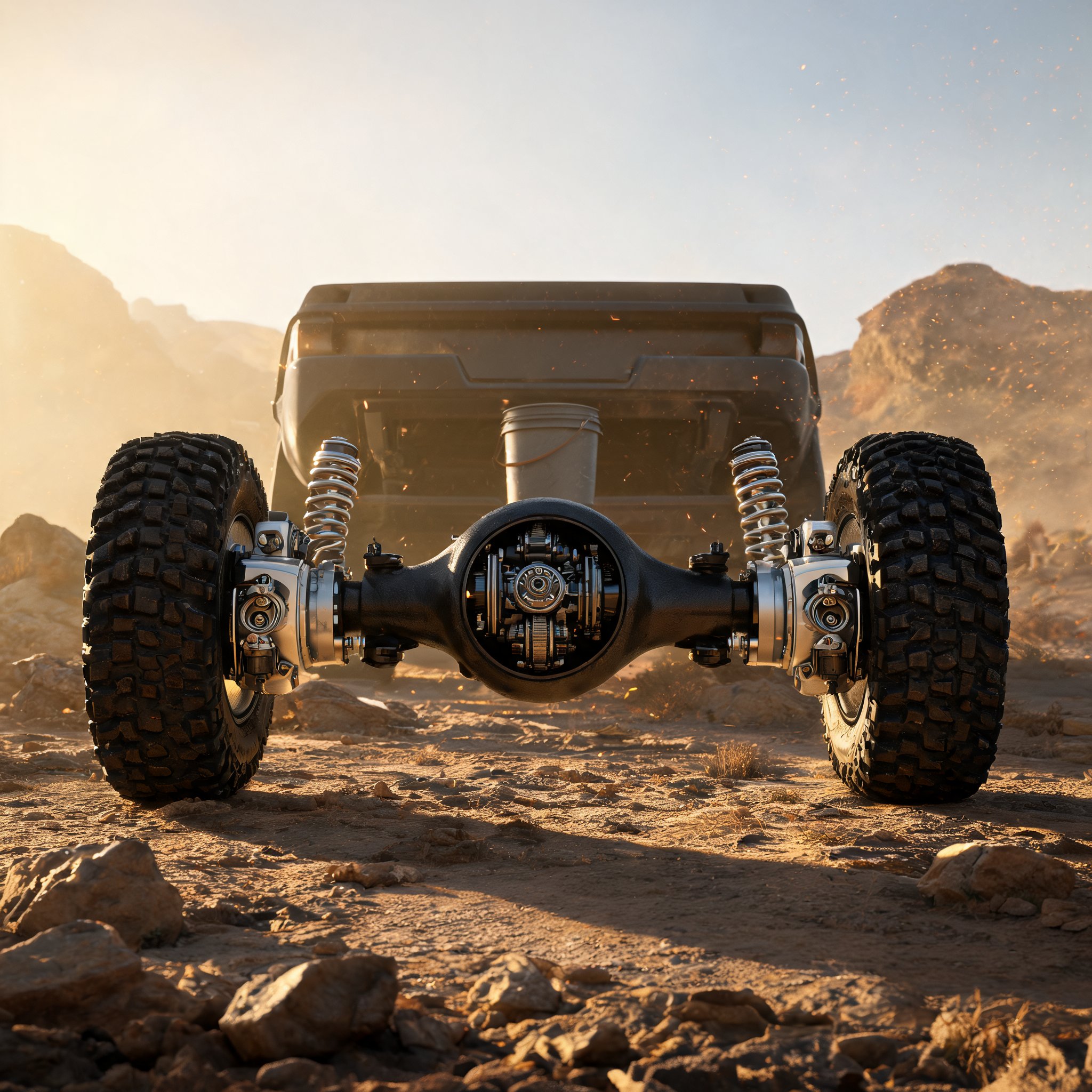
Zeph Gage has built a portal axle for the rear of his Jeep Cherokee XJ at roughly one-fifth the cost of a typical set, combining a Ford 9-inch axle housing, geared hubs taken from a Humvee and a set of Jesse Haines Fabrication HMMWV portal adapters. Portal axles from specialist suppliers such as 74Weld normally run about $20,000, so the appeal of Gage's approach is obvious — but it depends on substantial custom fabrication rather than a bolt-in kit.
What portal axles do
Portal axles put a stack of gears behind each driven wheel instead of letting shafts and other components hang down from the transmission and transfer case. As The Drive's Andrew Collins described after driving portal-equipped Ineos Grenadiers in the Arctic, that layout allows the axle shafts to sit high, leaving very little hardware below the frame line. Paired with tall tires — his test vehicle ran 37-inch BFGoodrich KM3 mud terrains — the arrangement frees enough ground clearance to, in his description, leave room for a picnic beneath the parked truck.
Turning the differential upside down
Two-gear portals of the Humvee type reverse the direction in which the input shaft turns. To compensate on the Ford 9-inch, Gage simply mounted the differential upside down so the driveline rotates the correct way. A Yukon Gear and Axle third member is then bolted to the diff, in effect converting low-pinion parts into a high-pinion unit by turning them over.
Besides adding six inches of clearance, the arrangement preserves full shock travel — a difficult thing to achieve with portal axles, according to the article — and reduces stress on the differential itself, which the builder expects to make the assembly effectively bulletproof.
Why rear only
Installing a portal at the back without matching the front is a common trick in the remote-control rock crawler scene. Retaining the solid front axle avoids the packaging constraints that typically appear when portals are added to a vehicle that never had them from the factory. It also means shock travel does not have to be restricted to work around those constraints, and ride height does not have to be raised excessively.
Custom parts and the result
The conversion is not an off-the-shelf solution. Gage made his own brackets, produced custom-tapped plates and built a two-piece brake rotor paired with a Ford Fusion caliper — hardware chosen partly for its integrated electric parking brake solenoid and partly, again, for clearance. The finished XJ can drive over a five-gallon bucket and still have several inches of clearance to spare, so the rear end is less likely to snag on obstacles the front can steer around. A video from Outdoor Auto covers further detail, including how gearing was matched front and rear.