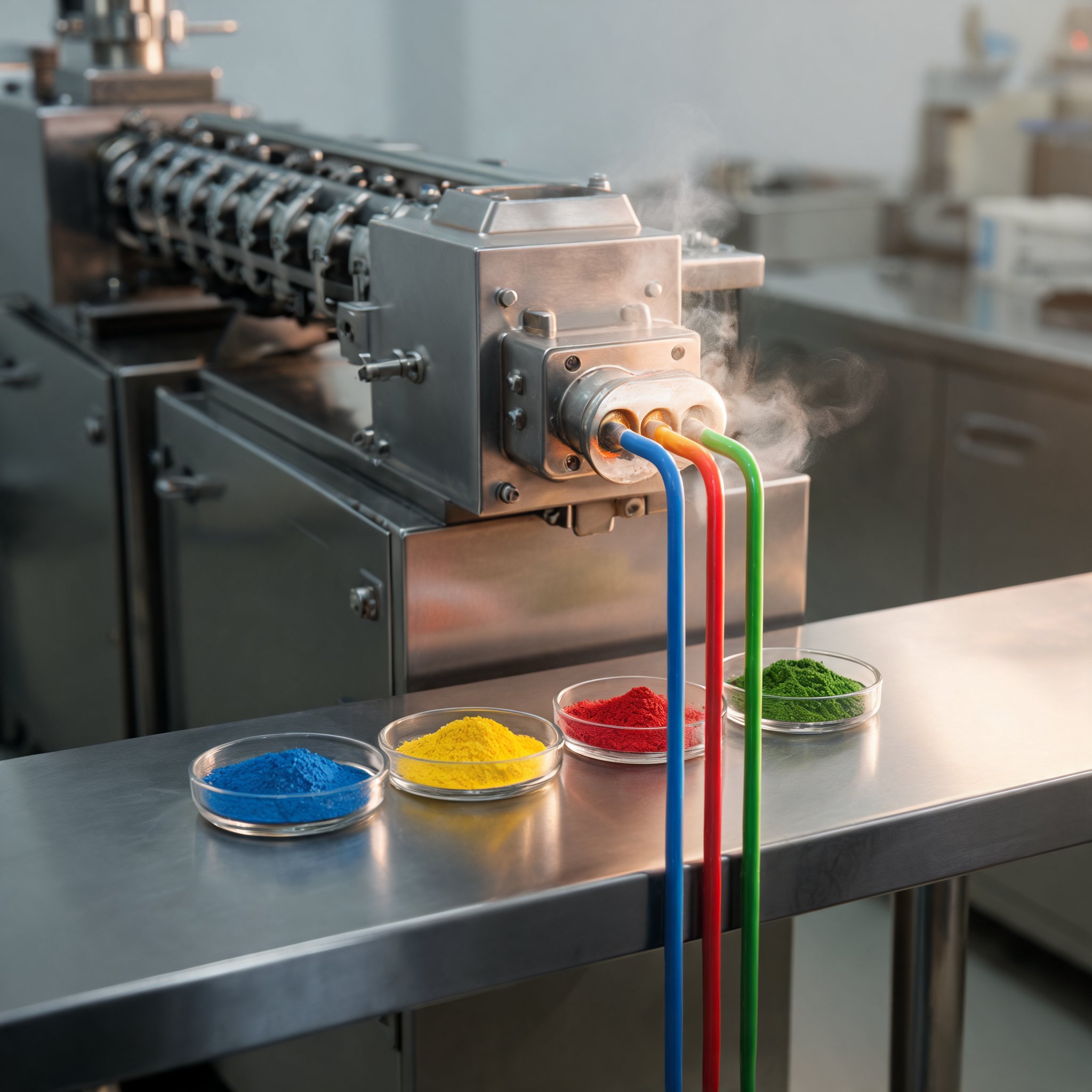
A new study has tested whether four commercial natural pigments can survive the melt-processing conditions used for polylactic acid (PLA) and polybutylene succinate (PBS), two biodegradable polymers. The work examined blue spirulina, yellow curcumin, red beetroot and green chlorophyllin in color masterbatches produced by twin-screw extrusion, then diluted into the matching polymer at 2, 4 and 6 wt% and injection molded into test specimens. The masterbatch formulations also contained titanium dioxide, calcium carbonate and stearic acid, added to support UV protection, dispersion and processing.
Thermal limits shape the processing window
Heat is the central constraint. The organic structures of natural pigments can begin to degrade at lower temperatures than the polymers they are added to. Thermogravimetric analysis put degradation onset at about 229 °C for spirulina, 244 °C for curcumin, 258 °C for chlorophyllin and 267 °C for beetroot. PLA and PBS degraded at considerably higher temperatures.
The researchers therefore selected extrusion profiles that melted each polymer while limiting the pigments' thermal exposure. Processing temperatures reached 145 °C for PBS and 190 °C for PLA, with the twin-screw extruder running at 65 rpm and a feed rate of 2 kg/h.
Most pigment-polymer combinations fit within that window, but spirulina was a notable exception. During PLA processing it lost its characteristic blue color, preventing production of a blue PLA masterbatch. PBS's lower processing temperature preserved enough pigment stability for successful compounding. The result shows that pigment compatibility depends strongly on the thermal requirements of the polymer matrix.
Melt flow and mechanical properties remain close to baseline
From a processing standpoint, the natural pigments caused only limited changes in rheological behavior. Melt flow rate decreased slightly after pigment incorporation, indicating a modest rise in melt viscosity. Neat PLA showed an MFR of about 50 g/10 min, and the corresponding natural-pigment masterbatches stayed close to that value. PBS responded similarly, with only a minor reduction in melt flow rate.
That matters for compounders. A natural color system would offer little practical value if it forced major changes to screw design, pressure settings or molding conditions. In this study, conventional twin-screw compounding and injection molding handled most formulations without major processing problems.
The researchers also checked tensile and impact behavior. Across the 2 to 6 wt% addition range, neither PLA nor PBS showed significant losses in overall mechanical performance. PLA started with a Young's modulus of about 1710 MPa and tensile strength of 65.6 MPa, while PBS started at about 392 MPa and 34.5 MPa. The colored formulations stayed close to those baselines. Impact strength also remained in a similar range, although individual pigments produced some variation.
Light exposure is the main barrier
Successful extrusion did not ensure long-term color stability. After 50 hours of xenon-lamp exposure, most formulations showed a color difference above ΔE* = 2, indicating a visually perceptible change. The PLA formulation containing 2 wt% green chlorophyllin masterbatch showed the highest photostability and remained the main exception.
The study therefore identifies UV stability as the largest barrier to broader use. Packaging, consumer products, agricultural parts and outdoor applications may require additional stabilization, protective coatings or pigment modification before natural colors can compete with conventional systems over long service periods.
The environmental comparison favored the natural pigments under the study's assumptions. One kilogram of curcumin pigment generated about 0.04 kg CO2-eq, compared with 18.65 kg CO2-eq for the inorganic green reference pigment. The natural-pigment masterbatches also consumed less electricity during extrusion and pelletizing.
Natural pigment masterbatches still require further development, particularly in lightfastness and thermal stability. Nevertheless, the study concludes that several natural colorants can be compounded into PLA and PBS using conventional processing equipment, with only limited changes in melt viscosity and mechanical performance. Future work should focus on improving color stability during processing and subsequent service exposure.