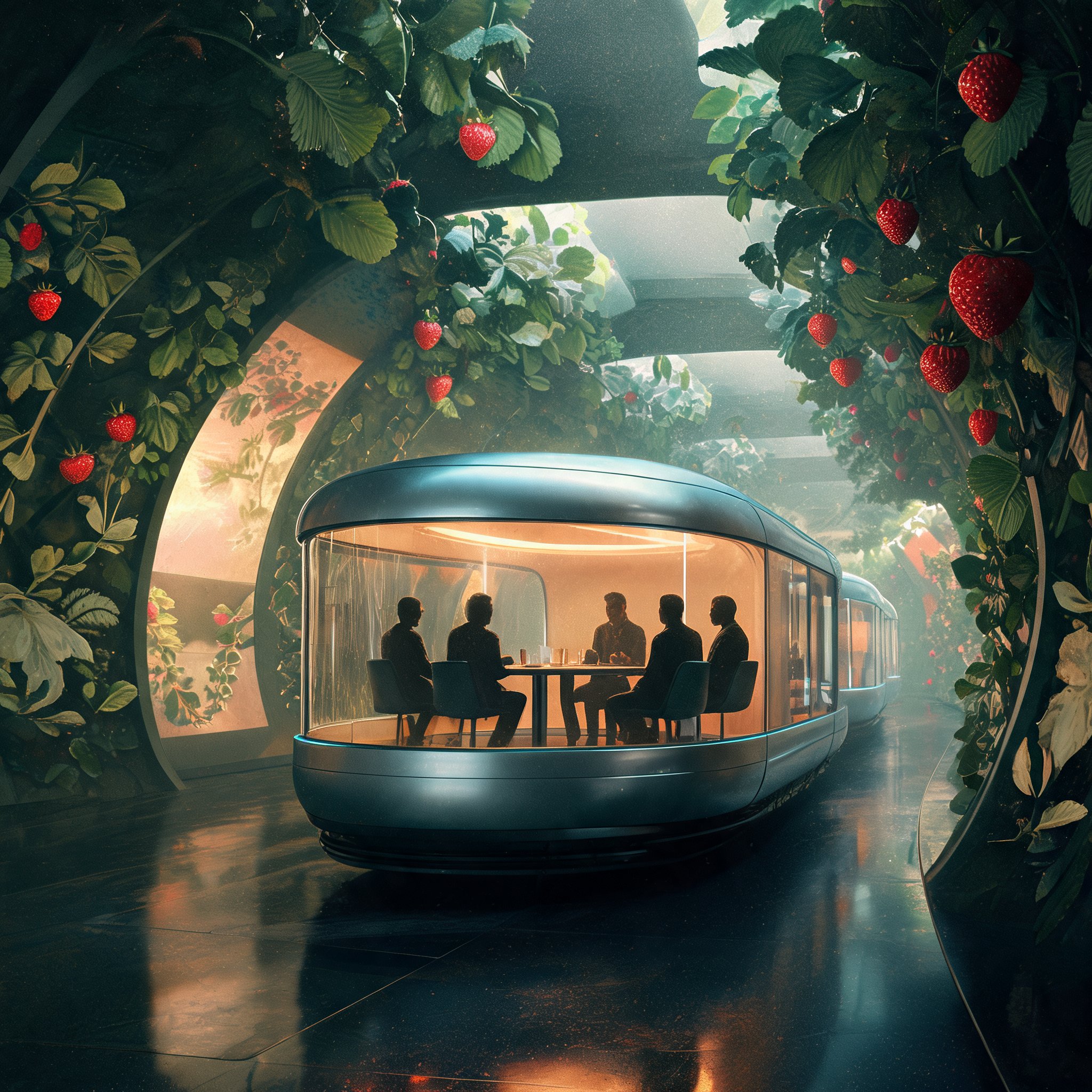
MACK One, the innovation and experience design arm of the MACK Group, has set out details of eatX, which it describes as the world's first Dark Ride Dining Attraction: a patented, commercially deployable format in which the meal and the ride are a single experience rather than two consecutive ones.
Guests board the FlowDiner, an autonomously moving, battery-powered dining vehicle developed and manufactured by MACK Rides. Each vehicle carries a group of up to four adults and two young children through a sequence of themed environments, and the story is delivered through projection, set design, lighting, soundscapes and the food at the same time. According to the company, neither element is subordinate: the food is not decoration for the ride, and the ride is not packaging for the food.
A vehicle designed for repeatable show
The FlowDiner took two years to develop. It travels at up to 0.5 metres per second on an on-board electric drive and operates as part of a trackless ride system, which means the layout and the narrative journey can be configured for each operator and each intellectual property. MACK One presents that adaptability as the platform's commercial engine: eatX is designed as a white-label concept that can be localised for a given brand, story or destination.
First installation at Karls Erlebnis-Dorf
The first commercial installation is planned for Karls Erlebnis-Dorf in Elstal, near Berlin, in summer 2027. The attraction, titled "Strawberry Dining Journey", takes guests through five themed worlds across a three-course menu and is built around the historically documented discovery of the garden strawberry in 1714. The narrative is grounded in Karls' stated brand themes of family, farming and authenticity, and is translated into a production combining projection, set construction, lighting design and choreographed cuisine. The story is identical for every guest; the company says the memory is unique to each table.
Positioning the format commercially
MACK One places eatX outside existing attraction or dining categories, at the intersection of ride engineering, immersive storytelling and system gastronomy. Its commercial case rests on three pressures it says operators in theme parks, resorts, family entertainment centres and arenas face at once: limited available space, demand for high-value guest experiences, and the need to grow revenue per square metre. The format is presented as answering all three within a single footprint, using each square metre twice - as attraction space and as dining revenue space.
For theme parks, the company positions it as a way to turn underperforming or legacy spaces into high-value destinations; for resorts, as a means of converting transitional dining into a storytelling asset; and for malls, family entertainment centres and stadia, as an anchor concept intended to drive dwell time, per-capita spend and social sharing from a compact footprint. MACK One describes the format as scalable, brand-agnostic and operationally lean, with system gastronomy supporting precision, throughput and quality, and the trackless system allowing layouts to be configured per site.
Engineering lineage and ownership model
The concept is presented as emerging from operating experience rather than from a design studio. The MACK Group developed Eatrenalin, described as a Michelin-starred immersive fine-dining restaurant at Europa-Park Resort, as a prototype for combining dining with storytelling; MACK Rides contributes its engineering history and MACK One its experience design role. The company argues that the combination gave eatX technical credibility and evidence of guest appetite before the first commercial unit was built.
Under the white-label model, the IP, the story and the brand identity belong to the operator, while eatX supplies the engineering and the format. MACK One characterises dining as "the gap between two better things" that the new format is intended to close permanently.