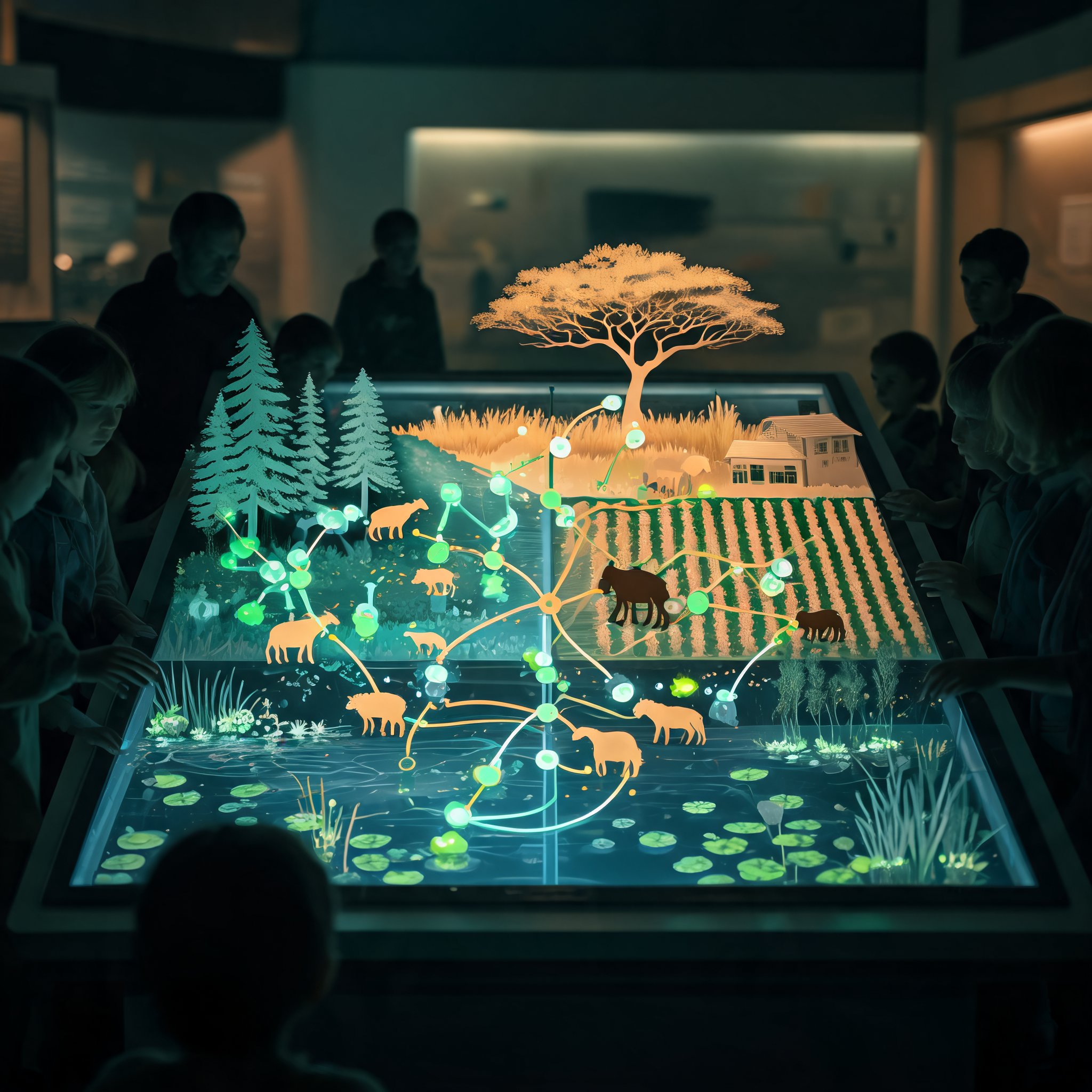
Lutra Interactive AB has developed EcoWeb, an interactive ecological simulation that lets visitors build, alter and observe food webs rather than simply read about biodiversity. The experience is designed to show how adding or removing a species can cascade through an ecosystem, with effects that may reach plants, herbivores and other species far from the initial change.
The project is built around a straightforward distinction: biodiversity is not only the number of species present, but also the interactions that connect them. Those connections, especially indirect effects, are difficult to convey through conventional exhibits, diagrams or lists of threatened species. EcoWeb turns them into a visible and manipulable model.
Empirical models, progressive interaction
EcoWeb combines ecological science, dynamic simulation and playful interaction. Its food webs are based on empirical data drawn from published ecological research, systematic literature reviews and species occurrence data, according to Lutra Interactive. The model includes both bottom-up and top-down effects so that changes can propagate through a network rather than stopping at directly connected species.
Visitors meet the system in stages. They begin with simple three-species food chains and test what happens when a species is added or removed. They then progress to larger food webs, different types and strengths of ecological interactions, and eventually complete networks with more than 100 species and over 1,000 interactions. Users can select individual species to reveal their connections and explore threatened species. In the Swedish forest ecosystem, they can move from recently cleared woodland to old-growth forest and observe changes in both biodiversity and the network itself.
Four ecosystems and real-world deployments
EcoWeb currently covers four contrasting ecosystems: the Serengeti savanna, Swedish boreal forest, an agricultural landscape and Lake Bolmen, one of Sweden's largest lakes. The same underlying approach can be applied across these settings while retaining locally relevant species, data and environmental challenges.
Developed with scientists and educators, EcoWeb has moved beyond prototype into real-world use. It has been installed as a touchscreen experience at Swedish science centres including Universeum in Gothenburg, Curiosum in Umeå and Visualization Center C in Norrköping. It is also accessible through the web for WWF Sweden. Lutra Interactive reports that visitors spend time exploring species and their connections, and that use with school groups has prompted discussion and reasoning about extinction, indirect effects and trophic cascades.
Sustainability through experimentation
The work is positioned in the sustainability field because it addresses biodiversity loss. Protecting biodiversity requires more than knowing that species are disappearing; it also requires understanding why those species matter and how ecosystems depend on relationships between them. EcoWeb is intended to let people experiment with ecosystems and see why those relationships matter, rather than simply being told that biodiversity is important. By making complex sustainability science tangible and interactive, the project aims to bridge ecological research, public understanding and awareness of the consequences of human impact on nature.