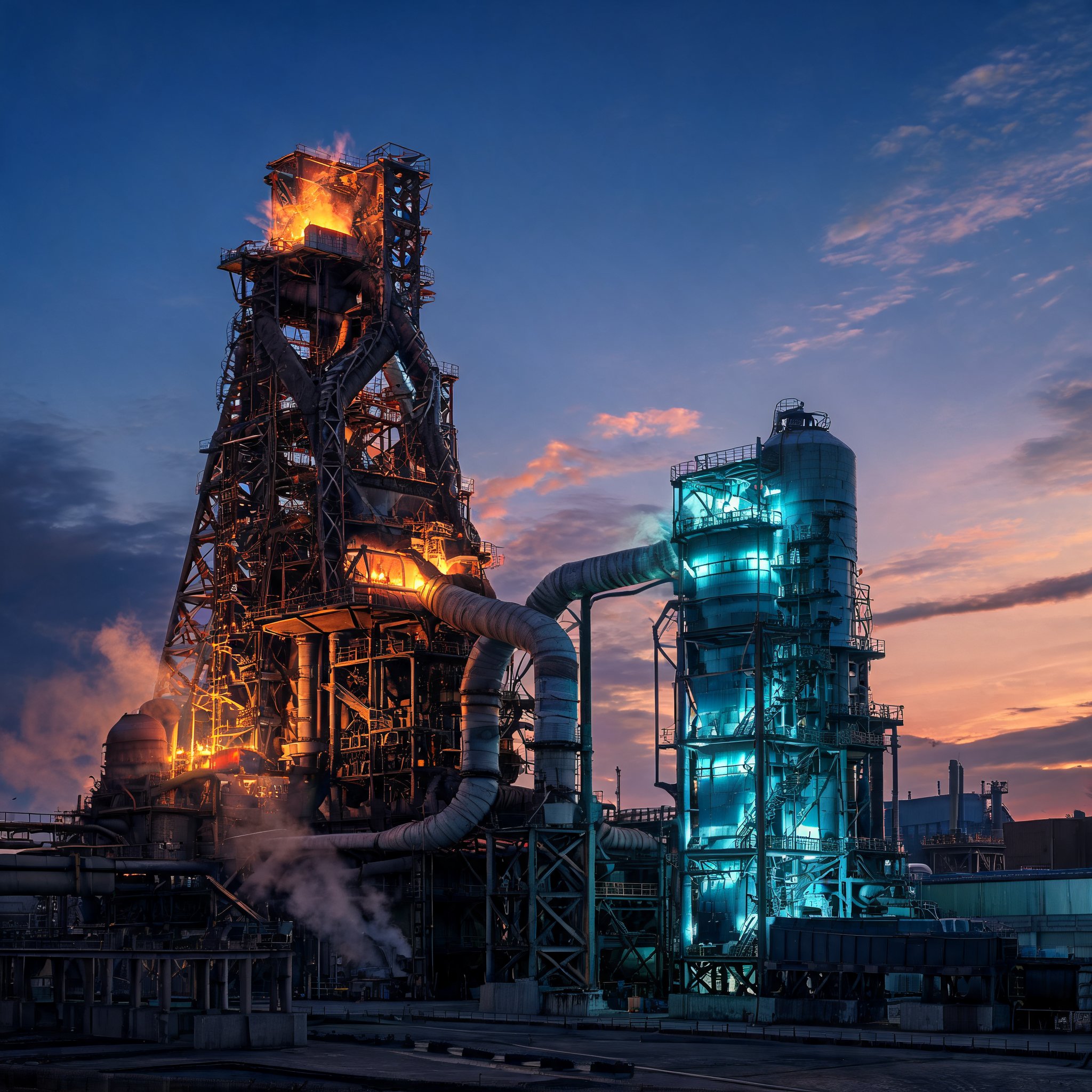
A carbon capture pilot at ArcelorMittal’s integrated steelmaking site in Gent, Belgium, has captured more than 90% of carbon dioxide from blast furnace gas, concluding its first phase. The trial used Mitsubishi Heavy Industries’ Advanced KM CDR Process and involved ArcelorMittal, MHI, BHP and Mitsubishi Development Pty Ltd.
The pilot operated for more than 4,500 hours and produced operational and engineering data intended to support an assessment of full-scale application at the Gent blast furnace. The partners said the test took place in a demanding environment where blast furnace off-gas carries dust, sulfur-containing compounds and other contaminants. Demonstrating capture under those conditions is central to judging whether the technology can be used more widely in steelmaking.
Potential site impact
Assessments based on the phase 1 results indicate that applying the technology at full scale to pre-combustion blast furnace off-gas could reduce CO2 intensity at the Gent site by up to 24%. The partners also said that applying carbon capture across multiple emission points at the steelmaking plant could support progress toward near-zero emissions intensity.
The first phase focused on capturing CO2 from a portion of the blast furnace off-gas. The gas contains significant concentrations of CO2 and carbon monoxide. Only CO2 was captured in this phase. The remaining carbon content, in the form of CO, can be used elsewhere at the integrated site for power and heat generation, with CO2 released when it is combusted.
Second phase
Phase 2 is planned to broaden the application of carbon capture across multiple emission points. It will include testing the technology on gases from the hot strip mill reheating furnace, which is fired with gas and heats thick steel slabs to the temperature required for rolling into thin sheets. Unlike the pre-combustion blast furnace gas test, this work will address post-combustion gases.
The reheating furnace uses a blend of by-product gases from steelmaking, including coke oven gas, blast furnace off-gas and basic oxygen furnace gas, together with natural gas. The second phase will assess MHI’s technology under a different and more dynamic flue-gas profile. The partners said the resulting data will inform updated engineering and deployment studies for future full-scale applications.
Roles and reactions
ArcelorMittal is facilitating the trial in Gent. MHI is supplying its proprietary Advanced KM CDR Process and leading carbon capture process engineering and technical evaluation. BHP and MDP, which supply high-quality steelmaking raw materials to ArcelorMittal’s European operations, are providing funding.
Frederik Van De Velde, CEO of ArcelorMittal Belgium, said the first stage had helped the partners better understand how carbon capture can be incorporated into existing steel plants. He described scaling up decarbonization technologies as the next step and said the blast furnace gas trial had provided important data.
Tatsuto Nagayasu, senior vice president and head of CCUS at MHI, said completing more than 4,500 hours of operation and exceeding 90% capture from blast furnace gas marked an important milestone for applying the company’s technology in steel. He said the campaign showed the process could operate under challenging blast furnace gas conditions while generating data for future commercial-scale design assessment.
Dr. Ben Ellis, vice president of marketing sustainability at BHP, said the results were promising and demonstrated abatement potential for the blast furnace and integrated steelmaking route. He noted that around 70% of global steel production comes from blast furnace steelmaking today and that the route is expected to remain important for decades, making emissions reduction from the process a priority alongside alternative steelmaking pathways.
Tadashi Mizuno, managing director and CEO of MDP, said the phase 1 results strengthened confidence that carbon capture applied to blast furnace gas could provide a viable pathway for reducing emissions from the steel sector. He said energy efficiency and high-quality raw materials would remain important in the near to medium term, while technologies such as CCUS could make a significant contribution to the industry’s long-term decarbonization.