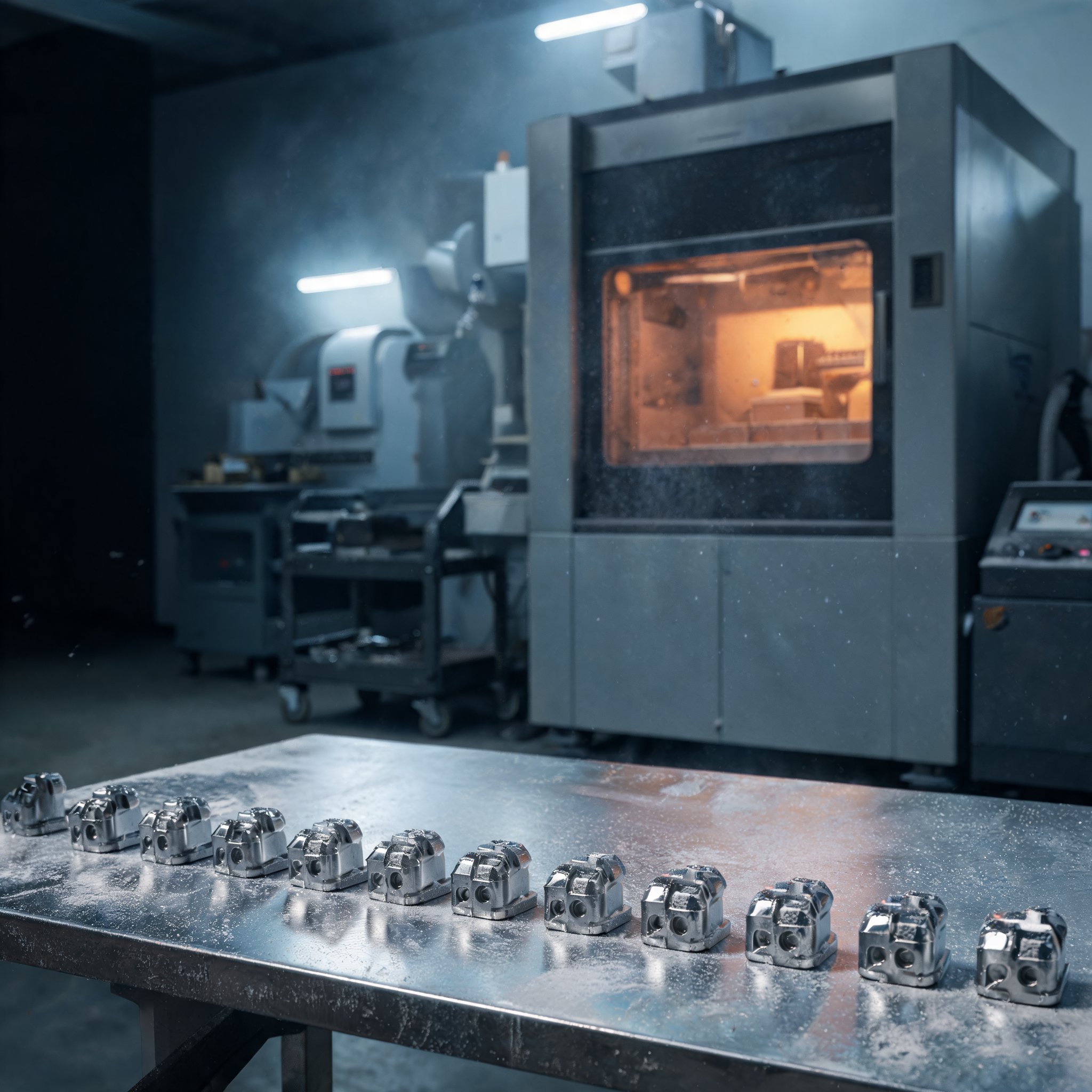
3T-AM, the Newbury-based metal additive manufacturer, now generates around 70% of its revenue from production work, according to commercial director Eddie Andrews, who joined the company in November 2021. Repeat orders give the business a base from which to choose development projects, even though new product introduction still absorbs roughly 80% of the team's time.
Andrews described the shift as a change of mindset rather than a single investment. When he arrived, the company knew how to make a one-off metal component for any one of hundreds of customers; the open question was how to win the order to make the same part again, at the agreed price and on schedule. "How do you make that boring?" he recalled. "How do you make that general manufacturing?"
The order book changed first
Previously, 3T-AM might have bought an EOS M400 to try a different material and see what business it could develop. Today, Andrews says, customers' programmes account for the capacity of incoming machines before they reach the factory. "The investment is quite boring, actually."
Semiconductor customers generate the strongest demand, followed by energy, then space and defence. Aerospace remains central to the company's plans, but 3T-AM has found work for its machines while it waits for more aerospace programmes to reach suppliers at volume.
Simplifying the shop floor
Andrews dates the business to 1997 and recalls its first metal machine arriving around 2008. By the 2021 reset, years of accommodating individual prototype jobs had left process after process on the shop floor. The company narrowed its customer base, gave its larger accounts more influence over what it developed and simplified the procedures that had accumulated. Much of the work remained manual while the team established which operations it could reliably repeat.
Who owns the finished part
Changing who took charge of a job mattered as much as changing equipment. When the first person to see a drawing was the engineer responsible for printing it, the natural question was how to print it, and decisions taken at that point shaped the work handed to everyone else. Today a product owner is responsible for delivering the finished component, and print and machining specialists agree what condition the part should be in as it passes from one operation to the next.
"To become a successful additive manufacturer, you need to be a really good CNC machining company," Andrews said. Bringing machining in-house gave the SME more control over its costs, quality and delivery dates, while larger multi-laser machines improved productivity at the printing stage. Neither investment on its own could tell a customer when a finished part would arrive.
The commercial transition was harder to time. Production orders rose and then tapered off, and turning away too much prototype work during the upswing would have left gaps when it eased. Repeat orders now give 3T-AM room to choose which development jobs to take, although Andrews notes that some will never become production contracts. "But if you don't take part in the journey, you're never going to find out."
Buying machines against orders
Austrian precision manufacturing group SBO acquired 3T-AM in October 2025. The Newbury business had generated around £5 million in sales in 2024. SBO brought experience in machining downhole drilling equipment, including components up to ten metres long; what interested the group was 3T-AM's metal printing expertise and access to a different set of industrial customers.
SBO approved 3T-AM's five-year business plan, and Andrews recalled the board asking whether it could be done quicker. In August 2026 the group reported that 3T-AM had added an EOS M400 in the second quarter, ordered another printer and invested further in post-processing, as part of a seven-printer expansion across its UK and US operations.
A full order book makes the next machine easier to justify, but it leaves little time on that machine to qualify a different material or develop a new product. Andrews wants to preserve two distinct reasons to invest: contracted demand, and the work 3T-AM cannot yet offer. He cites a pre-pandemic aerospace enquiry in which a single family of parts would have required 16 multi-laser systems to cover only a share of the requirement — one reason, in his view, why original equipment manufacturers still keep sizeable additive programmes in-house.
What the customer can measure
For some customers, replacing a casting with a printed part earns its keep through lead time alone: a legacy or development programme can obtain a component sooner, even at much the same unit cost. At higher volumes the calculation gets tougher, because machine maintenance contracts and consumables weigh on the hourly rate, and a factory working a single shift has fewer productive hours over which to spread those costs. Andrews sees scope to learn from CNC shops that operate around the clock, with support removal one area where automation could help.
A project with Honeywell Aerospace will put another claim to the test. Under an Aerospace Technology Institute-funded programme, the partners are converting an existing conventionally manufactured component to additive, and the sustainability team at the NCC in Bristol is carrying out a 12-month life-cycle assessment covering manufacture, service and end of life. Printing closer to the finished shape should use less feedstock and leave less metal to machine away than starting with billet, and the study will compare the two manufacturing routes alongside any benefit the redesigned component delivers in service.
3T-AM is also connecting its factory and enterprise systems to develop digital product passports documenting the carbon associated with making an individual component. By the end of 2028, Andrews wants that information to come with every part at no extra charge.